
Menstrual Equity Shouldn’t Be First Come, First Served
North Carolina’s grant program left 96 schools without period products. Here’s why that’s a public health failure.

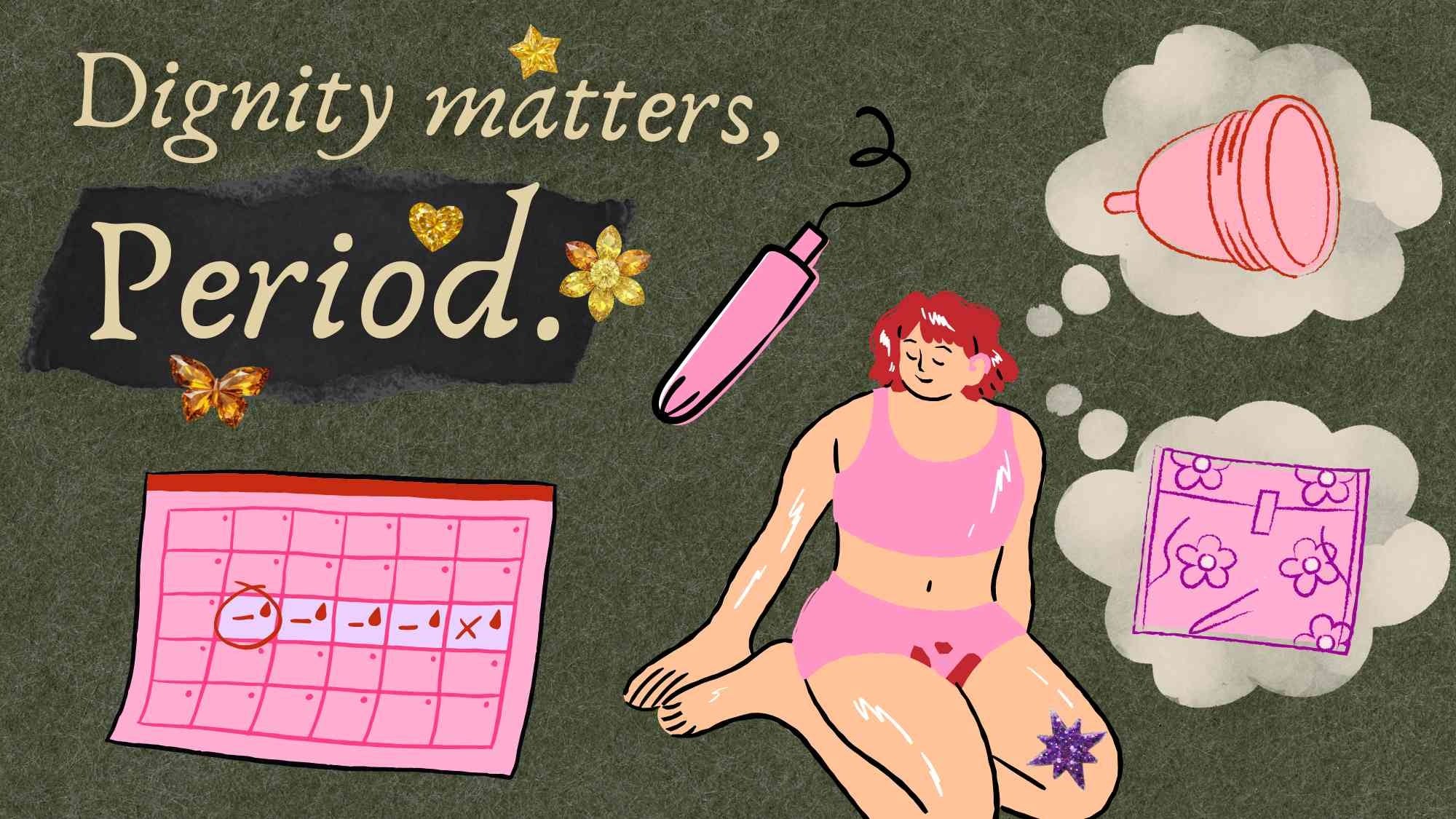
I’ve never had the kind of period that could be treated like a minor scheduling adjustment.
At its worst, I could bleed through a super tampon in fifteen minutes.
Unfortunately, that’s neither an exaggeration or a joke.
How the fuck are you supposed to stay on top of that in a classroom? That’s something I asked myself countless times growing up.
There was that time in my junior year of college when I was backstage, assistant stage managing a show. Within half an hour, I had bled all the way through my pants.
Talk about a fucking nightmare. I did NOT want to feel exposed or vulnerable among these young-Timothee-Chalamet-types.
Not in an environment where “paper plate” awards were a thing. (My school had a tradition where seniors would get together and decide what they found embarrassing, bad, or cringeworthy about you to then publicly give you an “award” naming your flaws.)
I could see it clear as day: a paper plate scribbled with red marker and some faux-clever title like, “Most Likely to Method Act as Carrie.”
I panic-texted my roommate.
She didn’t like me much that week. We were in that particular cold war that sometimes happens between college roommates over dishes, or partners, or some small thing that may or may not be a stand-in for something larger.
Still, she came through. She brought me a pair of black leggings and even told me I could keep them. I wouldn’t have to spend the rest of the night worrying about staining borrowed clothes on top of everything else.
The simple act of gifting me the pants felt tender. I wish everyone could have a ride-or-die friend like that. I aspire to be one myself.
I: dignity should not depend on who is nearby
I’ve been thinking about that memory while trying to write a policy paper about menstrual equity for grad school.
What stays with me is not only that my roommate helped, but how instinctively she did it. We were barely getting along, and she still knew this was not something to hold over my head.
She understood, almost instantly, what schools and policymakers still fail to grasp: dignity is not a favor, and access to menstrual care should not be treated like one.
This feels obvious to the folks who have lived through it, because the lesson is usually taught through embarrassment. (And menstrual humiliation starts so early for so many of us.)
Long before anyone offered me the language of “equity” or “bodily autonomy,” I had to learn what it means to panic, improvise, conceal, and hope someone nearby is kind.
Maybe that’s why I kept feeling like I was banging my head against a wall trying to translate the weight of these experiences into sanitized policy language that is true but bloodless, pun fully intended.
Because yes, some of the deepest solidarity I’ve seen has lived in purses, bathroom stalls, whispered check-ins, and someone handing you their hoodie to tie around your waist.
But students should not need luck, proximity, or social capital to avoid bleeding through their clothes at school.
“Do you have a pad?”
A whole political theory lives inside how we answer that question. As individuals, yes, but especially as our institutional policies.
II: the bathroom is already a public policy site
North Carolina’s Feminine Hygiene Products Grant Program (which does, to its credit, exist) received 235 applications from schools in 2024.
They funded 139.
That means 96 schools asked for help and were left empty-handed. It was “first come, first serve,” which is a cute little way of saying that the schools already most equipped to navigate bureaucracy had the best shot at getting help.
Better yet, it means the government is treating access to a basic biological necessity like buying tickets to a concert or rushing a flash sale.
But equity shouldn’t depend on whether your district had a grants coordinator with bandwidth in October.
And when a school doesn’t get funded, someone still fills the gap. NC Department of Public Instruction's own report documents teachers buying products out of pocket to be able to help students.
We are essentially holding our public health infrastructure together with underpaid educators’ debit cards and Tampax Pearls.
My roommate shouldn’t have to be better at protecting my dignity than a government with a multi-billion dollar budget.
I genuinely believe that if a twenty-year-old in a messy dorm can treat my body’s needs as non-negotiable, the state of North Carolina can, too.
We don’t make toilet paper a friendship-based resource. We don’t expect students to crowdsource hand soap or carry their own paper towels in their backpacks just in case. We recognize that a bathroom requires a baseline infrastructure to be functional as a building with mandatory attendance.
Menstrual products are in the same category.
A school bathroom that doesn’t account for the biological reality of half the people using it isn't a fully public facility.
We’ve built elaborate systems to make sure students show up. Attendance policies. Compulsory education laws. Truancy officers.
A school that requires your attendance owes you the conditions to attend.
And luck is a terrible public health strategy.
bleeding through the cracks,
-Alyssa ❤️
(Below, I’ve attached the policy brief I recently wrote for my class “Deconstructing Educational Policy.”)
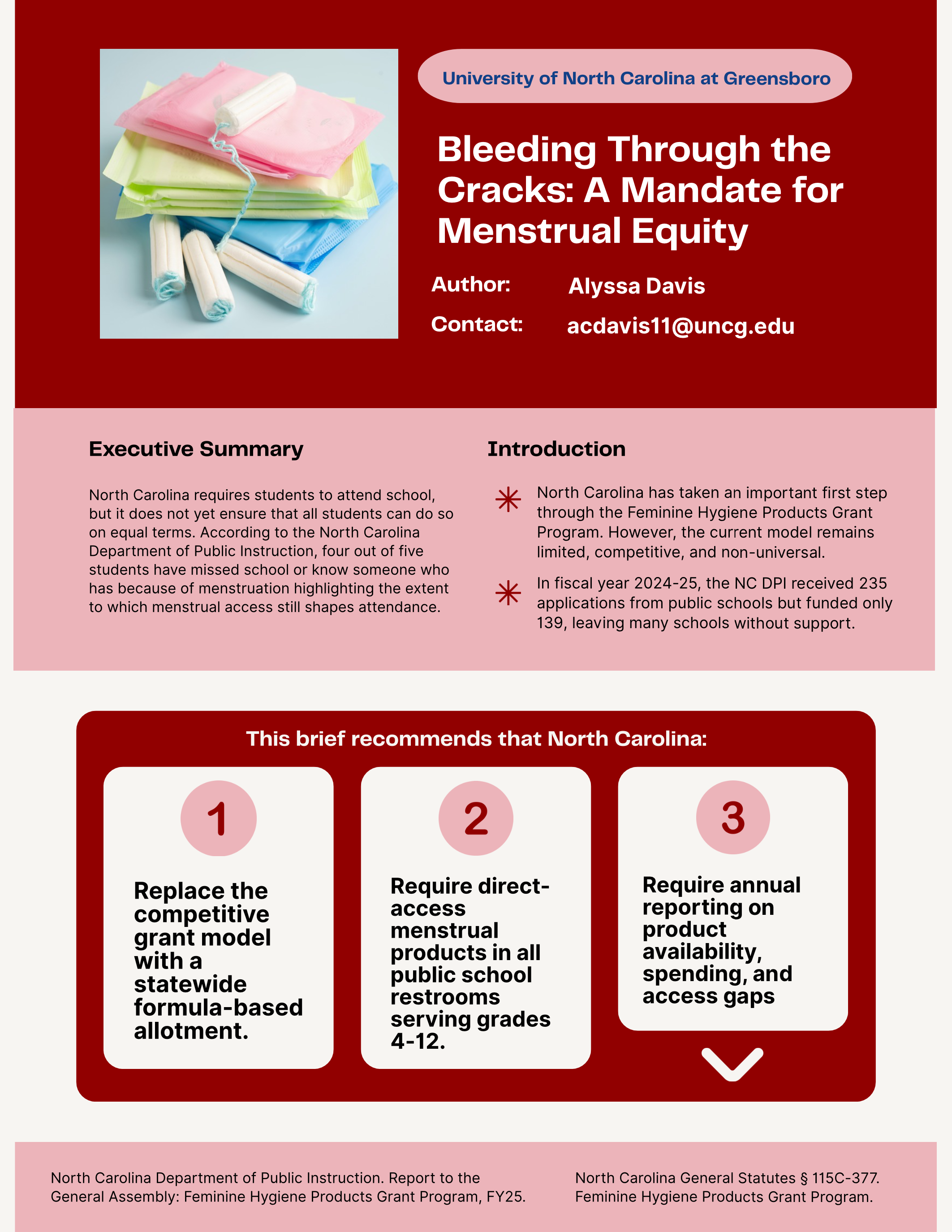
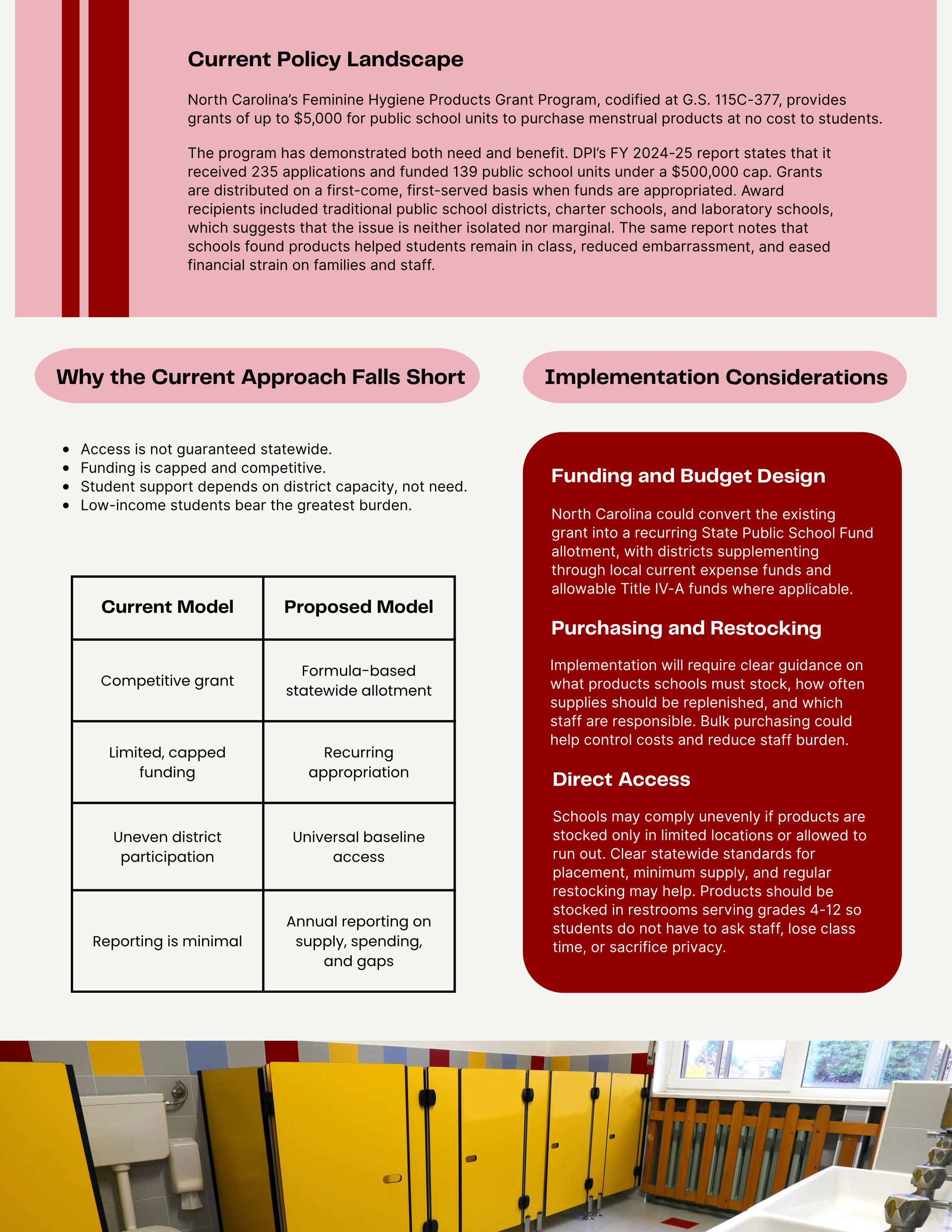
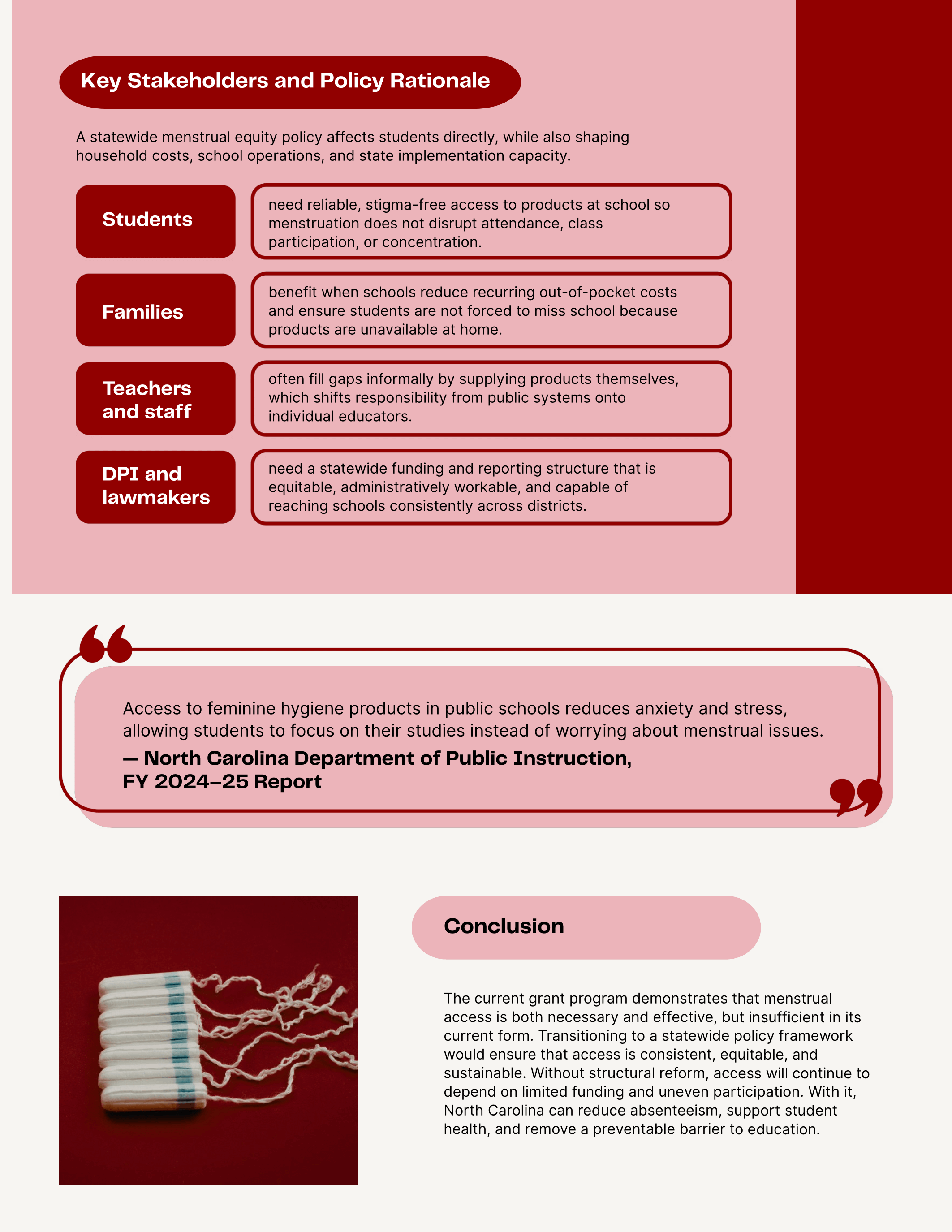
Luck is indeed a terrible public health strategy. Thanks for writing this🙏 very important. 📣
Great piece. This is so essential and rarely addressed!