
When a Student Becomes a Reportable Event
How North Carolina’s “Parents’ Bill of Rights” turns LGBTQ+ student identity into administrative information.

(cw: mentions of sexual assault)
Before I ever heard the phrase “Don’t Say Gay,” I knew not to say it.
I grew up homeschooled under Christian fundamentalism, which meant there were few meaningful boundaries between school, family, and religion.
The same adults who taught me were the adults who fed me, housed me, corrected me, punished me, and decided what parts of the world I was allowed to encounter.
There was no guidance counselor to confide in, no health class to learn sex-ed without the shame of purity culture, and no other queer kids to cling to for solidarity.
There were no teachers to forcibly out me to my parents, but I still understood very young that if my family ever got a whiff of me being queer, it would be bad. I spent years navigating that quiet terror.
My childhood was practically a case study of what happens when school, family, and religious surveillance become a single, unbroken loop.
That’s why I’m wary of any policy that treats parental control as automatically protective. Arguments like “parents deserve to know” hit different when you’ve seen folks being outed and kicked out, prayed over, institutionalized, or made homeless.
Do parents have a right to know their child is LGBTQ+ before that child is ready to tell them?
North Carolina Senate Bill 49 says “yes.”
And if you think this is just a local issue in a single Southern state, look closer.
I: The Architecture of Suspicion
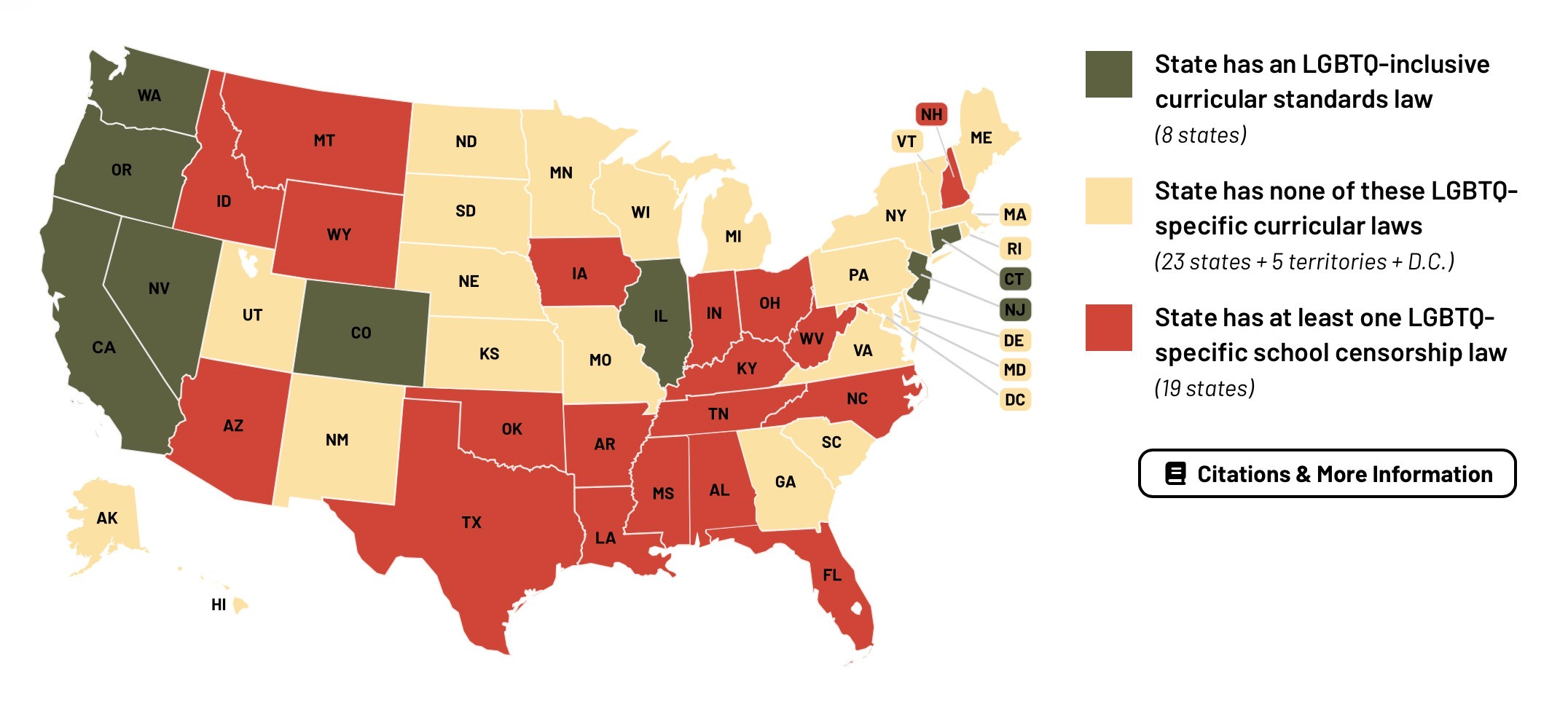
Even if you don’t follow North Carolina politics, you’ve probably heard of Florida’s “Don’t Say Gay” law, championed by Ron DeSantis.
That bill set off a wave of copycat legislation across the USA. In 2023, states like Arkansas, Iowa, Indiana, and Kentucky passed their own versions of these “Don’t Say LGBTQ” restrictions.
This policy genealogy is crucial for understanding SB49.
SB49 did not emerge organically from evidence of widespread parental exclusion in North Carolina’s public schools. Rather, Douglass, Scott, and Anderson describe how pre-formulated solutions are pushed by “conservative think tanks, venture philanthropists… and well-funded right-wing parent groups like Moms for Liberty.”
North Carolina’s Senate Bill 49 was enacted in 2023 after the Republican-majority General Assembly overrode Governor Roy Cooper’s veto, which he had issued on the grounds that the bill would actively harm LGBTQ+ students.
The law:
Prohibits instruction on “gender identity, sexual activity, or sexuality” in kindergarten through fourth grade.
Requires school personnel to notify parents of any changes in the name or pronoun used for a student.
Mandates processes for parents to inspect and challenge textbooks, instructional materials, and library resources.
Includes pathways to escalate unresolved concerns to the State Board of Education.
Last semester, I read the book The Politics of Education Policy in an Era of Inequality for one of my grad school classes. It suggests that that to analyze policies critically, we should look not just at what the policies say, but also at where they come from and who stands to benefit from them.
SB49 describes itself as “an act to enumerate the rights of parents to direct the upbringing, education, health care, and mental health of their minor children.”
Supporters refer to it as the “Parents’ Bill of Rights.”
But which parents? Whose rights?
Certainly not the parents of LGBTQ+ kids who want their children seen and supported.
“Parents’ rights” sounds universal, but SB49 does not treat all parents as equally worth listening to. It empowers the parent who wants queerness invisible, surveilled, or eliminated.
Are we really centering children when student voices only appear indirectly, as something to be reported, managed, or overridden? That’s the case with SB49.
A deeper look at the distribution of power and resources in these conversations leads us to zoom in on Bridget Ziegler, one of the co-founders of Moms for Liberty.
After years of stoking moral panic and accusing queer people of being “groomers,” the Zieglers’ own glass house shattered. Police reports revealed that Christian and Bridget Ziegler prowled pubs for threesome partners. Christian Ziegler was also accused of sexual assault and non-consensual filming, or video voyeurism.
The hypocrisy is staggering and grim.
This scandal matters because it shows the architecture of suspicion was constructed to only ever flow in one direction. Down.
American policies are being influenced by adults who fixate on monitoring and controlling young people’s gender and sexuality, while remaining remarkably uncurious about the implications of their own sexual politics.
Queer kids become objects of scrutiny, while adults with institutional authority get to privately treat sex like a game of domination, coercion, and conquest.
II: Forced Outing as a Tool of Containment
Children don’t owe anyone information about their gender or sexuality.
Yet, SB49 requires school personnel to notify parents of any changes in the name or pronouns used for a student in school records or by staff.
While civil rights advocates have described this as “forced outing,” supporters contend it is a necessary response to schools “keeping secrets” from parents.
For example, on NC Family’s “Family Policy Matters” podcast, Senator Amy Galey stated, “We’ve seen in the news from California… that you have California school districts that are encouraging children in gender transition behind the parents’ back and without the parents’ approval. And this bill would definitely prevent that, as well as other kinds of medical care.”
With this framing, parents are positioned as the primary victims, denied transparency and oversight.
But before we romanticize transparency, I want to know who gets protected after forced exposure. Because there is a kind of adult who calls it “secrecy” when a child has boundaries.
If a child trusts a teacher with questions or information about their identity before they trust their parents, the question shouldn’t be “how do we force disclosure?”
Maybe it’s “why didn’t home feel safe?”
When we picture “coming out,” it’s easy to conjure up the sanitized mental picture of a one-time announcement. Maybe a kitchen-table confession or a tearful phone call. Perhaps a social media post where folks flood the comments with “Yesssss,” heart emojis, and some version of “I see you and I love you.”
But in real life, coming out is rarely that simple.
More often, it is relational. It depends on context, timing, safety, trust, and delicate evaluation of who will listen without turning it into a weapon.
SB49’s reporting requirements strip LGBTQ+ students of the relational privacy that makes educational belonging possible.
When educators are positioned as compliance agents rather than relational supports, students lose access to forms of care that may be essential to their participation in school. Relational privacy recognizes that for marginalized students, a supportive teacher or counselor is not an extension of the family unit, but a distinct relational sphere where autonomy is practiced.
What happens when a child’s privacy is treated as a threat to parental rights?
The student’s own understanding of their gender or sexuality, their safety at home, and their capacity to participate in school as a full member of the community are made secondary to parental sovereignty.
In fact, the Campaign for Southern Equality argues that SB49 creates a “school surveillance infrastructure.”
Queer kids deserve adults who can tolerate not knowing everything long enough to become safe enough to be told.
III: Who Decides What Safety Means?
There is a particular violence in demanding a child “just be honest” when the adults around them have not proven they can hold honesty without punishment.
SB 49 does include an exception to its forced outing provision: teachers can withhold disclosure if a “reasonably prudent person” believes it would result in the child becoming an “abused juvenile or neglected juvenile”.
This is… unhelpful, at best. It presumes that public school educators possess an intimate, baseline knowledge of every student’s domestic life—an absurd expectation in underfunded classrooms where a teacher might see over a hundred students a day.
The North Carolina Justice Center (2023) argued that SB49 “unfairly targets” vulnerable LGBTQ children and contains provisions that would “hamstring school operations,” creating “harmful consequences for children, teachers, families, and schools that are already dealing with challenges from staffing shortages and vacancies.”
Plus, the clause leaves out many forms of relational harm that LGBTQ+ students may reasonably fear: rejection, humiliation, loss of housing stability, withdrawal of emotional or financial support, increased surveillance at home, or intensified conflict with caregivers.
More insidiously, it fails to account for the actual landscape of queer vulnerability, completely ignoring the quiet, material ways a family can dismantle a child’s life without ever breaking a law.
A parent who would never leave a physical mark that satisfies a social worker can legally cut off a youth's lifelines through total digital isolation, or privately fund abusive conversion therapy. They can legally authorize the forcible, middle-of-the-night removal of their child to an unregulated out-of-state Troubled Teen Industry program or behavioral modification wilderness camp.
Expecting a teacher to be able to predict these outcomes is absurd.
It makes no sense to require that a student must become legibly endangered before teachers are authorized to protect their privacy.
Queer kids deserve privacy without being treated as deceptive.
They deserve adults who understand that trust is built by becoming safe enough to be told the truth, not by demanding access to it.
For a lot of queer kids, privacy is not secrecy or shame. It is the small, fragile space where they get to figure out who they are before somebody else turns it into a crisis.
I want adults to be less obsessed with whether queer kids are “telling the truth” and be more curious about what kind of truth can survive in the home they’ve built.
IV: Queer, Not Contraband
There is something especially bleak about adults insisting children are “too young” to hear that queer people exist, while queer children are already living that reality in their own bodies.
SB49 presents parental review and complaint procedures as expanded participation. But Douglass, Scott, and Anderson warn that education policy must be read in relation to power, voice, and the unequal capacity of different actors to shape policy outcomes.
There’s a difference between participation that democratizes schooling and participation that redistributes power upward toward already legible complainants. In other words: are more parents actually being heard, or are the same parents being heard more loudly and more often?
SB49’s review provisions do not create equal deliberation among parents, students, educators, and marginalized communities.
Instead of recognizing teachers, counselors, librarians, and administrators as professionals capable of exercising care and judgment, SB49 casts them as potential ideological threats subject to monitoring.
When any parent can challenge materials and initiate a formal review process with escalation to the State Board of Education, educators are continually exposed to complaint procedures that incentivize self-censorship. This chilling effect, documented by multiple North Carolina educators, extends the law’s influence well beyond its written provisions (EdNC, 2026).
Even when a teacher, counselor, or librarian might technically be able to support LGBTQ+ students within the law, the threat of complaint, escalation, or professional scrutiny changes the conditions under which they work.
The law does not need to ban every affirming practice outright if it can make those practices feel administratively risky.
This is how chilling effects become governance… the law’s ambiguity invites over-enforcement.
The result is a school environment in which LGBTQ+ students may be present but conditionally so. Their belonging depends on whether their identities remain administratively manageable, parentally disclosed, and pedagogically contained.
V: Belonging as a Blunt Instrument
Ultimately, SB49 asks schools to treat LGBTQ+ student identity as a problem to manage. It asks students to navigate school with the knowledge that being known may also mean being exposed. And it asks the public to accept this as a neutral policy rather than as a redistribution of vulnerability.
Sometimes I grieve the version of me that might have existed without all that fear. The kid who could have had crushes without the icy breath of theology down her neck.
Grief like that is strange because the loss feels immense, even though at the time, I couldn’t have even imagined a world where coming out meant I was safe and accepted.
“Family values” shouldn’t be policy code for “your family gets to decide who you’re allowed to be.”
Queer kids don’t become safer when adults panic harder.
Queer people are not ideological contraband.
Can y’all just talk to your kids?? 😭
(Sorry, I was holding that in this whole time.)
queerly departed,
Alyssa 💜
Questions I was mulling over while writing this:
Who did you become before your parents knew who you were?
What do we lose when every act of self-discovery becomes a reportable event?
(for LGBTQ+ folks who grew up in conservative areas): Does Florida’s legislation feel like a repeat of something you already survived, or does it feel different?
P.S. If you loved this, consider becoming a paid subscriber! This Substack is 100% paywall free, and your contribution can help keep it that way.
Suggested Next Read:
